


01.08.2026
99
CITIZENS ON HUMAN TRAFFICKING: AWARENESS, CAUSES, CONSEQUENCES AND COUNTERMEASURES

The Republican Center for the Study of Public Opinion “Ijtimoiy Fikr” conducts systematic, comprehensive and scientifically grounded monitoring studies addressing one of the most acute and alarming challenges of the modern world — human trafficking. This issue not only poses a serious threat to the security of citizens and society in our country, but also gives rise to legitimate concern within the international community.
The surveys conducted by the Center are particularly relevant and timely, as they reflect changes in public sentiment and citizens’ perceptions of the real risks they may face both within the country and abroad. Amid globalisation, expanding migration flows and ongoing social transformations, such studies are becoming a powerful instrument for social diagnosis and analysis.
The data obtained through these surveys are of considerable practical value and may be used by the competent authorities and other relevant institutions to develop more effective, targeted and comprehensive measures aimed at preventing human trafficking, identifying and suppressing all of its manifestations, and eliminating the factors that facilitate exploitation — ranging from socioeconomic conditions to cultural and institutional circumstances.
The principal objective of the studies is to monitor citizens’ awareness of human trafficking, their understanding of the causes and consequences of trafficking-related crimes, and their views regarding the effectiveness of measures taken to counter human trafficking.
The nationwide representativeness of the surveys is ensured through the use of a multistage stratified sampling method, combined with the random selection of districts, settlements, mahallas, households and respondents. Data are collected through face-to-face interviews conducted at respondents’ homes using a single standardised questionnaire.
Monitoring of the public opinion surveys conducted in recent years indicates that public awareness of human trafficking has remained consistently high. The majority of respondents stated that they were well informed about the issue. This demonstrates the effectiveness of measures undertaken in the country to raise awareness among broad sections of the population and suggests that educational initiatives implemented by government agencies, human rights organisations and the mass media are achieving their intended objectives.
The substantial decline in the number of people unfamiliar with the problem of human trafficking confirms the effectiveness of systematic efforts to raise public awareness. Nevertheless, to ensure the long-term effectiveness of measures against this form of crime and minimise the risk of misconceptions spreading, information strategies must continue to be improved, with particular attention paid not only to the scale of audience coverage but also to the quality of the information provided.It is important that citizens’ awareness of human trafficking should not remain limited to general knowledge, but should include a clear understanding of the nature and consequences of the crime, as well as the practical means of protection against it.
The survey findings show that television remains the primary source of information on human trafficking, cited by 76.8% of respondents, and continues to serve as the leading and most authoritative channel of mass communication. Social media rank second in popularity, at 54.1%. However, content distributed through social media is frequently susceptible to distortion, highlighting the need to improve media literacy. Print publications and online news platforms also continue to play an important role.
The survey revealed that information on human trafficking primarily focuses on methods of recruitment and deception, mentioned by 48.3% of respondents, as well as general information about the issue, cited by 41.2%. Real-life stories of victims are also widely disseminated, at 34.8%.By contrast, the punishment of offenders is discussed less frequently, at 25.7%, as are the available channels for seeking assistance, at 21.5%. Given that the prevailing information environment is largely centred on general warnings, while analytical information and practical protection mechanisms receive less attention, it is necessary to expand public access to information on ways of protecting oneself from human trafficking.Analytical and statistical data should be disseminated more actively to foster a deeper understanding of the issue, access to legal information should be broadened, and real-life cases of human trafficking should be used more extensively to raise public awareness and strengthen prevention.
According to citizens, the main reasons for insufficient awareness of human trafficking are limited interest in the subject and a shortage of educational programmes. Addressing this problem requires improvements in awareness-raising activities within the country’s educational institutions, stronger information campaigns and more effective use of social media.Citizens should also be encouraged to participate more actively in discussions on human trafficking. Access to reliable information should be expanded, and different social groups should be involved in preventive initiatives. An important aspect of this work is fostering a sense of responsibility among citizens for the safety of others and creating conditions for open discussion of the issue.
The study found that the majority of respondents, 73.2%, are well informed about where to seek assistance if they become involved in a situation of human trafficking or exploitation. A further 12.6% have a general understanding of where to turn, while 14.2% do not know where they could seek help.
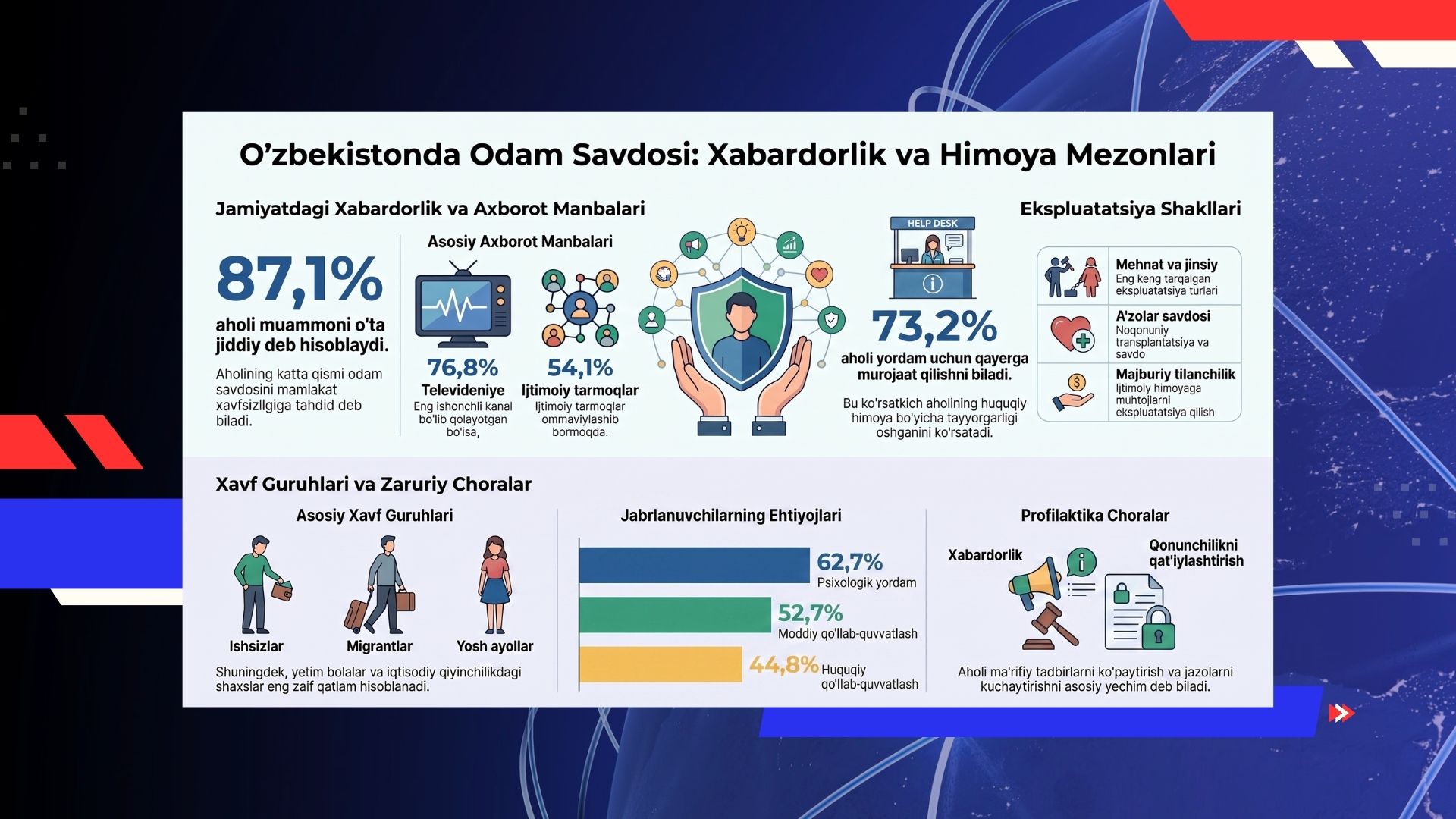
The results demonstrate a high level of public recognition of the problem of human trafficking. Most respondents, 87.1%, described it as a very serious issue, confirming a strong awareness of the threats associated with trafficking and exploitation, as well as recognition of its severity and relevance to national security as a whole.
The survey found that labour exploitation — the use of people as a source of cheap labour — is perceived as the most widespread form of human trafficking. Sexual exploitation ranks second in terms of prevalence.Participants also referred to such forms as illegal organ transplantation and trafficking in human organs, forced begging and trafficking in children for the purpose of illegal adoption. Respondents also acknowledged the existence of forced marriages, highlighting the seriousness of coerced entry into marriage. Exploitation within the family likewise remains a significant concern, closely linked to domestic violence and forced labour within households.
The principal factors contributing to citizens falling into human trafficking networks include the desire to earn money quickly, insufficient legal literacy, a lack of critical thinking, excessive trust, limited awareness of this type of crime and the desire to travel abroad.
The survey showed that the highest risk of human trafficking exists among unemployed people, young women, orphaned children, labour migrants and young men, particularly when seeking employment abroad. People with low levels of education and those experiencing financial hardship constitute an additional vulnerable group.
Based on the findings, it may be concluded that although most respondents have not personally encountered human trafficking, the phenomenon remains a pressing threat of which a significant proportion of the population is aware, particularly through examples involving people in their immediate social environment.This indicates that the problem remains hidden but real, underscoring the need to strengthen preventive measures, increase public awareness and further develop institutional efforts in this area. Human trafficking requires a comprehensive response that includes not only awareness-raising initiatives but also a deeper examination of the social and psychological factors that increase citizens’ vulnerability.
The study found that offers of employment abroad remain the principal means through which people are drawn into exploitation. This highlights the importance of monitoring migration flows and preventing recruitment through false promises of employment.Friends and relatives also play a significant role in recruitment, confirming that personal relationships and established trust may be exploited in the process of drawing individuals into situations of exploitation.
The survey results indicate that, in most cases, citizens were ultimately released from situations of human trafficking and exploitation. This suggests that despite the difficulties and risks involved, victims and their relatives did not remain indifferent and attempted to find ways to secure assistance.In most cases, victims were freed through the actions of relatives, law enforcement agencies or the efforts of the victims themselves. Nevertheless, despite these efforts, human trafficking remains a reality, and in some cases victims continue to live under conditions of exploitation.
The study found that after gaining their freedom, many victims sought assistance, primarily legal, medical and psychological support, to restore their rights and return to a normal life.However, not all victims are able or willing to take this step, often due to fear, stigmatisation and insufficient awareness of the assistance available to them. This demonstrates that human trafficking remains one of the most serious and brutal social problems and requires a comprehensive response.It is necessary not only to increase public awareness and develop preventive programmes, but also to provide victims with support at every stage. Particular attention should be paid to regions characterised by high levels of migration and concentrations of vulnerable population groups, where effective assistance and prevention are especially important.
The findings demonstrate a high level of public confidence in the efforts of government institutions in Uzbekistan to combat human trafficking. Most respondents believe that sufficient measures are being taken in the country to address the phenomenon, thereby recognising the effectiveness of existing mechanisms for preventing and suppressing crimes in this area.
Public opinion reflects a comprehensive demand for assistance in which non-material forms of support — psychological, social and legal — are accorded particular importance.This trend is clearly reflected in the survey findings regarding the priority forms of assistance required by victims of human trafficking. According to respondents, psychological support is the most important form of assistance, at 62.7%, reflecting recognition of the depth of the trauma experienced by victims.This is followed by financial assistance, at 52.7%, and legal support, at 44.8%, highlighting the importance of financial stability and legal protection. Assistance with employment, at 41.7%, and medical care, at 36.2%, are also viewed as essential components of recovery, while the provision of temporary accommodation, at 11.5%, is likewise regarded as an important measure.
Public perceptions of human trafficking prevention in Uzbekistan are based on a combination of informational, legal, economic and international approaches.A total of 58.3% of respondents emphasised the need to raise public awareness, demonstrating the growing importance of education and awareness-raising as long-term preventive measures. Support for stricter legislation, expressed by 43.5% of respondents, reflects public demand for justice and stronger legal protection.At the same time, 32.6% of respondents highlighted the importance of international cooperation, while 28.3% pointed to the need to improve socioeconomic conditions.
An analysis of public perceptions regarding the distribution of responsibility for combating human trafficking demonstrates a high degree of trust in government institutions. Law enforcement agencies are assigned the leading role by 68.9% of respondents, while 48.3% identify the Ministry of Foreign Affairs and 44.6% the Ministry of Employment and Poverty Reduction as key actors.Educational institutions and the mass media receive comparatively less attention. This indicates the need to broaden their participation in preventive and educational activities and to strengthen cross-sectoral cooperation in implementing these tasks.
Most survey participants, 79.5%, believe that education about the risks of human trafficking should begin before adolescence — during preschool, primary or secondary education.This reflects a growing public understanding of the importance of developing basic safety skills in children from an early age, teaching them to recognise potential threats and enabling them to seek assistance in a timely manner.It may be concluded that the focus of civic engagement in countering human trafficking is increasingly shifting towards educational, volunteer and human rights activities.
Almost half of respondents, 48.4%, are prepared to participate in educational initiatives. More than one third are willing to become involved in volunteer activities, at 33.8%, and legal support, at 32.7%.This reflects not only a high level of social maturity but also a demand for practical forms of participation accessible to a broad audience. Sustained interest in these areas may provide a foundation for developing inclusive and large-scale forms of public involvement in preventive efforts.
The findings indicate that a culture of awareness and preventive behaviour is gradually emerging among the population. Most respondents demonstrate a willingness to protect themselves and their relatives from the risks associated with human trafficking, while expressing a high degree of confidence in government institutions and in their own knowledge. At the same time, there remains a need to broaden access to legal information, improve mechanisms of legal support and strengthen the channels through which people can seek assistance.
Overall, the study confirms that human trafficking is a multidimensional social phenomenon rooted in a range of socioeconomic, personal and cultural factors that increase the vulnerability of particular population groups.The greatest risk of becoming involved in human trafficking networks exists among people for whom difficult life circumstances, economic instability and insufficient awareness serve as catalysts for exploitation.Those experiencing economic hardship are particularly vulnerable, including unemployed people, labour migrants, young women and men, and children from disadvantaged families. Their social circumstances and lack of adequate support create conditions that may be exploited by traffickers.Psychological and emotional factors, including excessive trust, naivety, lack of self-confidence and low self-esteem, also substantially increase vulnerability by making individuals more susceptible to manipulation by human traffickers.Effective action against human trafficking requires consideration of the full range of risk and vulnerability factors, including socioeconomic, psychological, emotional and systemic factors.The findings emphasise the need for a comprehensive approach that includes strengthening social protection, improving education and public awareness, developing the legal infrastructure and expanding international cooperation in order to protect vulnerable population groups.